Medical Crutches Market Overview & Analysis
The Medical Crutches Market size was valued at USD 945.2 million in 2026 and is projected to reach USD 1.41 billion by 2033, expanding at a compound annual growth rate of 5.9% over the forecast period. This steady upward trajectory reflects rising global incidences of musculoskeletal disorders, traumatic injuries, orthopedic surgeries, and an aging population that increasingly requires mobility assistance devices. The Medical Crutches Market share is distributed across a competitive landscape of global manufacturers, regional distributors, and specialized medical device companies, with North America currently commanding the leading position. Growing awareness about patient rehabilitation, coupled with favorable reimbursement policies in developed economies, continues to attract investment into product innovation and geographic expansion across more than 45 countries worldwide.
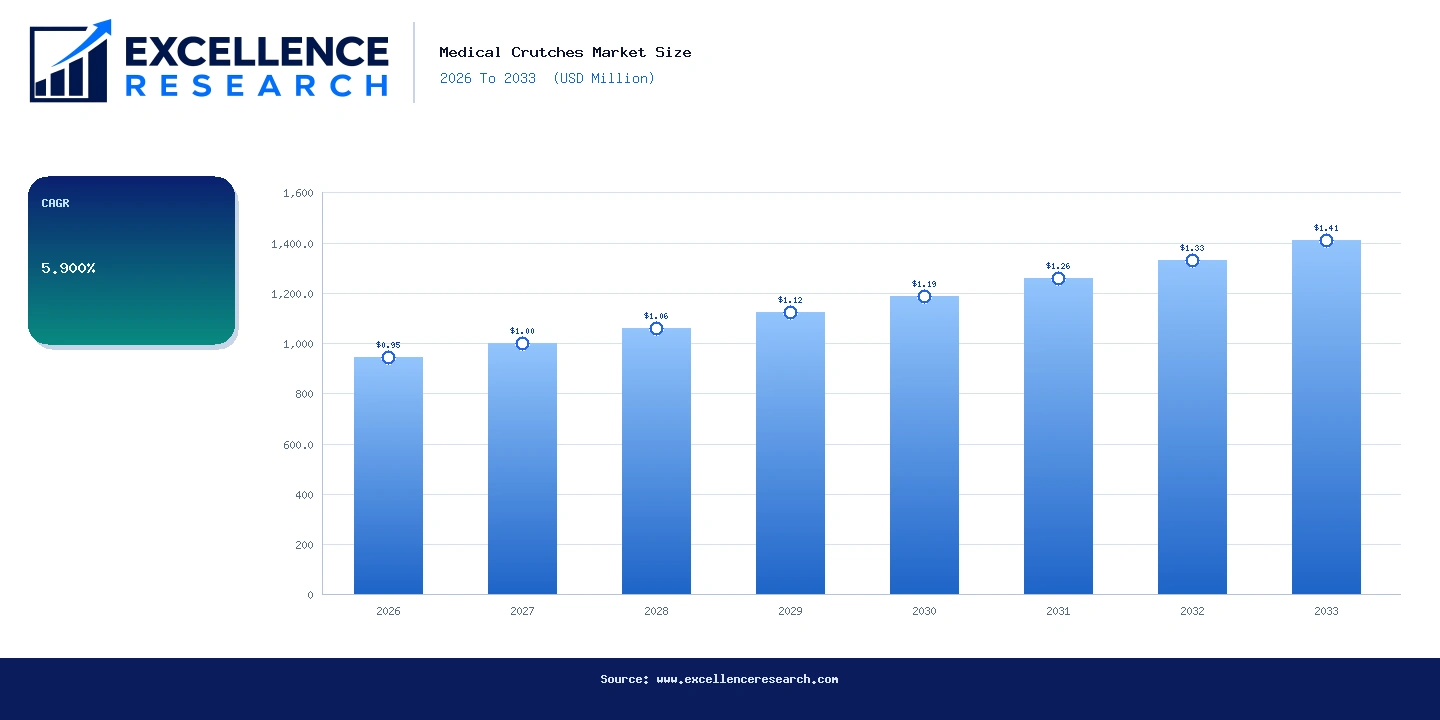
Key Report Takeaways
- By Product: Underarm crutches held the largest share in 2026 due to widespread clinical adoption and low unit cost, while forearm crutches are the fastest-growing segment driven by superior ergonomics and long-term user preference among chronic mobility patients.
- By Material: Metal alloy dominated revenue in 2026 owing to its durability, affordability, and established manufacturing supply chains, while carbon or glass fiber reinforced composites are the fastest-growing material segment as lightweight advanced materials gain traction among active and younger patient cohorts.
- By End-use: Adults accounted for the largest end-use segment in 2026 reflecting higher incidence of orthopedic conditions and post-surgical recovery needs among the adult population, while the children segment is growing at a faster pace supported by rising pediatric orthopedic intervention rates globally.
Market Drivers
The primary driver accelerating Medical Crutches Market growth is the global increase in orthopedic injuries and surgeries. According to the World Health Organization, musculoskeletal conditions affect approximately 1.71 billion people worldwide, and that number continues to climb alongside aging demographics in economies such as the United States, Germany, Japan, and China. The U.S. alone performs over 790,000 knee replacement surgeries and more than 540,000 hip replacement surgeries annually, each generating direct demand for post-operative mobility aids including crutches. The growing prevalence of diabetes-related foot complications, sports injuries among younger populations, and road traffic accidents in emerging markets such as India and Brazil further reinforces the structural demand supporting this market.
Technological advancement in materials science and product design represents another substantial driver. Companies including IWALKFree, Millennial Medical, and Sunrise Medical have invested significantly in ergonomic redesign, hands-free crutch mechanisms, and composite material integration that reduce fatigue and improve patient compliance. The shift toward outpatient and home-based rehabilitation models, accelerated by post-pandemic healthcare restructuring, has increased direct-to-consumer crutch sales through e-commerce platforms and home medical equipment retailers. Healthcare expenditure increases across Asia Pacific countries including South Korea, Australia, and Singapore are also expanding the addressable market substantially. These converging trends form the structural foundation captured in the latest Medical Crutches Market report.
Segment Analysis
By Product: Underarm crutches, also referred to as axillary crutches, retained the dominant product position in 2026 with an estimated 42% revenue share, favored in acute care settings and short-term recovery scenarios. Their low cost of production and wide availability through companies such as Medline Industries and Cardinal Health make them the default recommendation in hospital discharge protocols. Forearm crutches, also called elbow or Lofstrand crutches, are capturing growing interest particularly in Europe and among long-term users managing conditions such as cerebral palsy and multiple sclerosis. Tetrapod crutches, offering a four-point base for enhanced stability, are gaining traction among elderly patients in assisted living environments. Leg support crutches, including hands-free devices pioneered by IWALKFree, represent an emerging niche that is reshaping the product innovation agenda, targeting active patients recovering from below-knee injuries.
By Material: Metal alloy crutches, predominantly aluminum-based, accounted for approximately 58% of total market revenue in 2026 due to their corrosion resistance, recyclability, and cost-effectiveness at scale. Manufacturers such as Nova Medical Products and AMG Medical rely heavily on aluminum alloy construction across their standard product portfolios. Wood-based crutches retain a residual market presence primarily in low-income regions of sub-Saharan Africa and parts of South Asia where manufacturing cost constraints limit access to advanced materials. Carbon fiber and glass fiber reinforced composites represent the innovation frontier, offering weight reductions of 30% to 40% compared to aluminum equivalents. Breg, Inc. and Millennial Medical are among the companies exploring composite integration, positioning premium composite crutches for sports medicine and high-activity patient segments willing to absorb the higher price point.
By End-use: The adult segment generated approximately 74% of global Medical Crutches Market revenue in 2026, driven by post-surgical recovery needs, sports injuries, and age-related mobility impairment. Adults aged 55 and above represent a particularly high-value sub-segment as they require longer recovery periods and more durable equipment. The children segment, while smaller in absolute terms, is expanding at a notably faster rate, supported by rising early diagnosis of pediatric orthopedic conditions such as Legg-Calve-Perthes disease, clubfoot, and juvenile arthritis. Chinesport and Home Medical Products have developed pediatric-specific crutch lines that address height adjustability, lighter weight requirements, and child-friendly aesthetics, capturing growing demand from pediatric rehabilitation centers across Europe and North America.
Regional Analysis
North America dominates the Medical Crutches Market with approximately 38% revenue share in 2026, underpinned by its advanced healthcare infrastructure, high per-capita healthcare expenditure of over USD 12,500 in the United States, and a well-established network of home medical equipment distributors. Companies including Medline Industries, Cardinal Health, and Nova Medical Products operate extensive U.S. distribution networks that serve hospitals, ambulatory surgical centers, and retail pharmacy chains. The U.S. Centers for Medicare and Medicaid Services continues to reimburse crutches as durable medical equipment under Part B coverage, which significantly reduces the out-of-pocket barrier for patients and sustains consistent demand volumes. Canada also contributes meaningfully to regional revenue, supported by provincial health coverage programs that include mobility aids in their benefit schedules.
Europe holds the second-largest position in the global Medical Crutches Market analysis, accounting for approximately 28% of market revenue in 2026. Germany, France, the United Kingdom, and Italy are the leading national markets, all characterized by universal healthcare systems that fund crutch procurement through national health service channels. The European medical device regulatory framework under the Medical Device Regulation (MDR) 2017/745 has raised product quality standards and compliance requirements, encouraging consolidation among smaller manufacturers and favoring established players such as Chinesport, which holds a strong foothold in the Italian and broader Mediterranean market. The aging demographic across Western Europe, with populations aged 65 and above exceeding 20% in several countries, sustains structural long-term demand.
Asia Pacific is the fastest-growing region in the Medical Crutches Market forecast period, projected to achieve a CAGR exceeding 7.2% through 2033. China and India together account for over 60% of regional revenue, driven by large populations, rapidly expanding private hospital networks, and government initiatives targeting orthopedic healthcare access under programs such as India's Ayushman Bharat. Japan and South Korea contribute premium market segments where advanced composite and ergonomic crutch designs are gaining consumer acceptance. Rising disposable incomes, increasing sports participation, and growing medical tourism in Thailand and Malaysia are additional growth catalysts. Regional manufacturers are competing aggressively on price, which is intensifying competitive dynamics and driving innovation investment among established global players seeking to defend market position.
Competitive Landscape
The global Medical Crutches Market is moderately fragmented, with the top 10 players collectively holding an estimated 55% to 60% of total revenue in 2026. Sunrise Medical leads the competitive landscape through its diversified mobility product portfolio and global distribution infrastructure spanning over 130 countries. Medline Industries and Cardinal Health leverage their broad healthcare supply chain relationships to maintain high-volume institutional sales across North American hospitals and surgical centers. Nova Medical Products competes strongly in the retail and home health segment, offering a wide range of adjustable aluminum crutches at accessible price points. IWALKFree differentiates through its patented hands-free crutch technology, which eliminates the axillary contact point entirely and has attracted considerable attention in sports medicine and active patient communities. Millennial Medical focuses on comfort-oriented accessories and ergonomic handle innovations that serve as both standalone sales and upgrade components for existing crutch users. AMG Medical and Home Medical Products serve regional distribution roles in Canada and the United States respectively, while Chinesport maintains its competitive positioning across European institutional channels. The Medical Crutches Market trends indicate that product differentiation through ergonomics, weight reduction, and digital health integration will increasingly determine competitive advantage over the coming five years.
Recent Developments
- 2024: Sunrise Medical announced the launch of its updated Quickie Crutch Series featuring an integrated weight-bearing sensor designed to assist post-surgical rehabilitation monitoring, targeting hospital discharge programs across the United States and Germany.
- 2023: IWALKFree secured Series B funding of USD 18 million to accelerate international distribution of its iWALK 3.0 hands-free crutch into European and Australian markets, with distribution agreements signed with three regional medical device distributors.
- 2023: Medline Industries expanded its crutch product line with a pediatric aluminum crutch series incorporating height adjustment increments of 0.5 inches to better accommodate children aged 4 to 12, distributed initially through 2,400 U.S. pediatric hospital accounts.
- 2022: Chinesport introduced a carbon fiber forearm crutch weighing under 300 grams per unit, targeting the
Key Research Takeaways
Report Scope & Coverage
| Attribute | Details |
|---|---|
| Report Title | Medical Crutches Market |
| Base Year | 2026 |
| Historical Period | 2021 To 2025 |
| Forecast Period | 2026 To 2033 |
| Market Size (2026) | $945M |
| Market Size (2033) | $1,412M |
| CAGR | 5.900% |
| Regions Covered | Global (45+ countries) |
| Segments Covered | Product, Material, And End-use |
| Companies Covered | Sunrise Medical, Nova Medical Products, Millennial Medical, Medline Industries, Chinesport, IWALKFree, Cardinal Health, Home Medical Products, AMG Medical, Breg, Inc. |
Segmentation Covered
Key Companies Profiled (10)
Full profiles include company overview, product portfolio, revenue, SWOT analysis, recent developments, and strategic initiatives.
Related Press Releases & News
Frequently Asked Questions — Medical Crutches Market
You May Also Like
Specialist in Medical Devices market intelligence.
Schedule Free Analyst Call