Public Transportation Market Overview & Analysis
The Public Transportation Market size stood at approximately USD 312.5 billion in 2026 and is projected to reach USD 553.17 billion by 2033, expanding at a compound annual growth rate of 8.5% over the forecast period. This robust trajectory reflects surging urban population density, escalating fuel costs for private vehicles, and a decisive shift in government infrastructure spending toward mass mobility solutions. The Public Transportation Market share is increasingly concentrated among state-backed operators and large multinational transit service providers who are leveraging digitization, electrification, and public-private partnerships to capture ridership at scale. With coverage spanning more than 45 countries across six continents, the market presents differentiated growth opportunities shaped by local regulatory frameworks, demographic pressures, and modal infrastructure maturity.
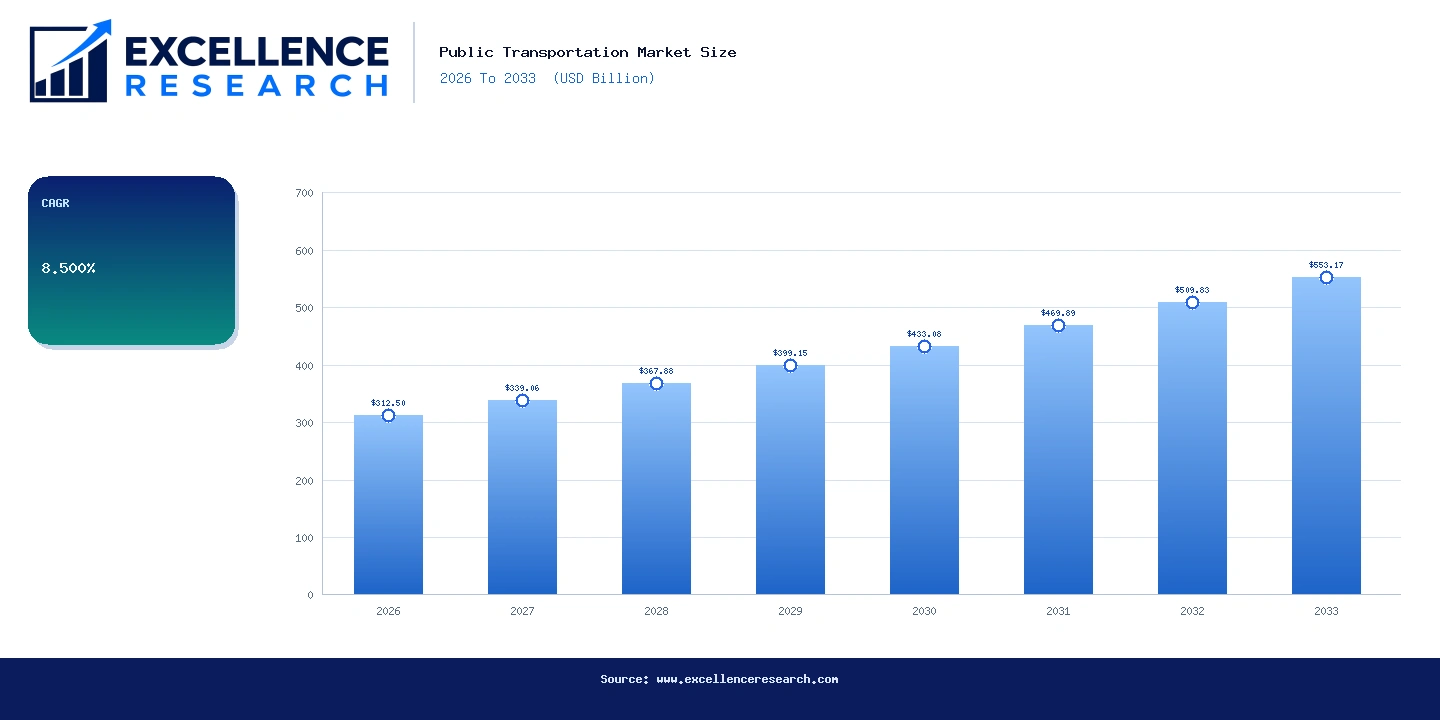
Key Report Takeaways
- By Distribution Channel: Offline channels held the largest share in 2026, accounting for roughly 61% of total ticket and pass revenues, while Online channels are the fastest-growing segment, driven by mobile ticketing adoption and contactless payment integration across major transit networks.
- By Mode Type: Rail dominated the Public Transportation Market with an estimated 54% revenue share in 2026, supported by high-speed and commuter rail investments from operators such as Deutsche Bahn AG and East Japan Railway Company, while the Road segment is the fastest-growing mode type due to rapid bus rapid transit corridor expansions across emerging economies.
Market Drivers
Urbanization remains the single most powerful catalyst underpinning Public Transportation Market growth. The United Nations projects that 68% of the world population will live in urban areas by 2050, intensifying demand for scalable, cost-efficient mobility infrastructure. Megacities in Asia, Latin America, and Africa are investing heavily in metro rail, bus rapid transit, and light rail networks to alleviate road congestion that already costs economies hundreds of billions of dollars annually in lost productivity. Governments in the European Union committed over EUR 100 billion toward sustainable urban mobility plans under the 2021 to 2027 Multiannual Financial Framework, directly channeling funds to operators like Transport for London and Keolis S.A. for fleet electrification and network expansion.
Environmental policy is an equally significant driver. More than 130 national governments have formalized net-zero or carbon neutrality pledges, and public transportation is widely recognized as one of the fastest routes to decarbonizing the mobility sector. A fully loaded commuter train produces approximately 90% fewer carbon emissions per passenger kilometer than a single-occupancy gasoline vehicle. This metric is shaping procurement policies, with agencies such as the Metropolitan Transportation Authority in New York and MTR Corporation Limited in Hong Kong committing to all-electric or hydrogen-powered fleets by the early 2030s. Rising consumer fuel prices and vehicle ownership costs are simultaneously pushing commuters toward public transit alternatives, sustaining ridership volumes well above pre-pandemic baselines in most developed markets.
Segment Analysis
By Distribution Channel: The offline distribution channel, encompassing station kiosks, agent-sold passes, and onboard cash fare collection, retained dominant revenue share at approximately 61% in 2026 due to persistent digital access gaps in developing markets and the habitual purchasing behavior of older rider demographics. However, the online channel is expanding at an accelerated pace, with mobile and web-based ticketing platforms projected to grow at a CAGR exceeding 12% through 2033. Operators including Transport for London, which processed more than 3 billion contactless transactions across its network, and the Toronto Transit Commission are investing heavily in open-loop payment infrastructure that enables riders to tap credit and debit cards directly at turnstiles. Aggregator platforms and journey planning applications are further consolidating online purchasing behavior, with third-party distribution through apps such as Citymapper and Google Maps driving measurable ridership uplift for operators integrated into those ecosystems.
By Mode Type: Rail dominated total market revenues in 2026 with an estimated 54% share, underpinned by the capital-intensive but high-capacity infrastructure operated by entities such as East Japan Railway Company, which serves approximately 17 million passengers daily, Deutsche Bahn AG across its 33,000-kilometer network in Germany, and Trenitalia c2c Limited across key UK commuter corridors. Investment pipelines for urban metro and high-speed intercity rail remain robust globally, with India alone earmarking USD 24 billion for new metro projects between 2023 and 2027. The Road segment, encompassing bus rapid transit systems, urban bus networks, and coach services, is the fastest-growing mode type given its lower capital threshold relative to rail. BC Transit Corporation in British Columbia and the Southern California Regional Rail Authority, operating as Metrolink, are representative of North American agencies expanding their road and multimodal service offerings. The Others category, which includes ferry, cable car, and emerging autonomous shuttle systems, accounts for a smaller but strategically important share as cities pilot innovative last-mile connectivity solutions.
Regional Analysis
Asia Pacific dominates the Public Transportation Market with an estimated 42% revenue share in 2026, anchored by the dense, high-ridership transit ecosystems of China, Japan, South Korea, and India. East Japan Railway Company alone generated revenues exceeding JPY 2.5 trillion in fiscal 2023, while MTR Corporation Limited in Hong Kong sustains one of the world's highest farebox recovery ratios at approximately 186%. China's continued metro network expansion, with over 9,500 kilometers of urban rail now operational across more than 55 cities, ensures Asia Pacific will retain its leadership position through the forecast horizon. Government subsidization levels remain high across the region, ensuring fare accessibility and sustained ridership volumes that reinforce the Public Transportation Market forecast of sustained dominance for this geography.
Europe represents the second-largest regional market, holding approximately 29% share in 2026. The region benefits from deeply embedded public transit culture, comprehensive regulatory support through EU mobility directives, and extensive cross-border rail cooperation. Berliner Verkehrsbetriebe in Germany, the Brussels Transport Company known as STIB-MIVB in Belgium, Transport for London in the United Kingdom, and Transdev operating across France, the Netherlands, and Scandinavia collectively reflect the diversity and scale of European public transit. The European Commission's commitment to achieving a 90% reduction in transport emissions by 2050 is accelerating fleet electrification spending, estimated at EUR 35 billion across member states through 2030. This Public Transportation Market analysis indicates Europe will grow at approximately 7.8% CAGR, slightly below the global average, reflecting market maturity offset by strong policy tailwinds.
North America accounts for an estimated 18% of global market revenue in 2026 and is characterized by a transit landscape dominated by publicly funded agencies operating under complex multi-jurisdictional governance structures. The Metropolitan Transportation Authority in New York manages one of the world's largest transit systems with an annual budget exceeding USD 19 billion. The Southern California Regional Rail Authority and Transport International Holdings Limited are investing in fleet modernization and service frequency improvements to rebuild post-pandemic ridership. Federal funding from the United States Infrastructure Investment and Jobs Act, allocating USD 89.9 billion specifically for public transit over five years, represents the largest federal commitment to public transportation in American history and is expected to translate into measurable service expansion and ridership growth contributing to North American market trajectory through 2033.
Competitive Landscape
The competitive environment described in this Public Transportation Market report is fundamentally shaped by the dual presence of government-owned monopoly operators and increasingly internationalized private concession holders. State-owned enterprises such as Deutsche Bahn AG, East Japan Railway Company, and TOBU RAILWAY CO. LTD. dominate their respective domestic markets through integrated infrastructure ownership and operational mandates. Meanwhile, multinational private operators led by Keolis S.A., Transdev, and MTR Corporation Limited compete aggressively for concession contracts across Europe, Asia, and North America, winning business on the basis of operational efficiency, technology integration, and fare revenue management capabilities. Keolis, a subsidiary of SNCF, operates in 16 countries serving more than 3.4 billion passengers annually, exemplifying the scale achieved by leading concession operators. The Public Transportation Market share among private operators is growing steadily as governments seek to reduce fiscal burdens through performance-based contracting models that transfer operational risk while retaining public ownership of infrastructure. Technology differentiation is emerging as a competitive axis, with operators investing in real-time passenger information systems, predictive maintenance platforms, and integrated mobility-as-a-service offerings to attract and retain riders in markets where private vehicle and ride-hailing alternatives remain persistent competitors.
Recent Developments
- 2024: Transport for London announced a USD 6.8 billion capital investment program targeting the modernization of the Piccadilly line rolling stock, with Siemens Mobility contracted to deliver 94 new trains incorporating regenerative braking technology capable of returning up to 20% of energy consumed back to the grid.
- 2023: Deutsche Bahn AG launched the Germany-wide 49-euro monthly transit pass known as the Deutschlandticket, resulting in the issuance of more than 11 million subscriptions within the first six months, materially increasing modal shift from private vehicles and establishing a model being studied by transit agencies across Europe.
- 2023: MTR Corporation Limited secured a 10-year concession extension to operate the Sydney Metro and South Western Sydney rail networks in Australia, valued at approximately AUD 1.2 billion, expanding its international footprint and reinforcing its position as one of the most commercially successful transit operators globally.
- 2024: Keolis S.A. was awarded a contract to operate and maintain the entire bus rapid transit network in Riyadh, Saudi Arabia, covering 85 routes and an expected daily ridership of 500,000 passengers, representing one of the largest single transit concession awards in the Middle East and underscoring the Public Transportation Market trends toward privatized operations in rapidly urbanizing Gulf Cooperation Council markets.
Key Research Takeaways
Report Scope & Coverage
| Attribute | Details |
|---|---|
| Report Title | Public Transportation Market |
| Base Year | 2026 |
| Historical Period | 2021 To 2025 |
| Forecast Period | 2026 To 2033 |
| Market Size (2026) | $312.50B |
| Market Size (2033) | $553.17B |
| CAGR | 8.500% |
| Regions Covered | Global (45+ countries) |
| Segments Covered | Distribution Channel, And Mode Type |
| Companies Covered | BC Transit Corporation, Berliner Verkehrsbetriebe, Deutsche Bahn AG, East Japan Railway Company, Keolis S.A., MTR Corporation Limited, Metropolitan Transportation Authority (MTA), Southern California Regional Rail Authority (Metrolink), The Brussels Transport Company (STIB-MIVB), Transport for London (TfL), Transport International Holdings Limited, Trenitalia c2c Limited and others |
Segmentation Covered
Key Companies Profiled (15)
Full profiles include company overview, product portfolio, revenue, SWOT analysis, recent developments, and strategic initiatives.
Related Press Releases & News
Frequently Asked Questions — Public Transportation Market
You May Also Like
Specialist in Automotive & Transportation market intelligence.
Schedule Free Analyst Call